
A Tale of Two Rhinos
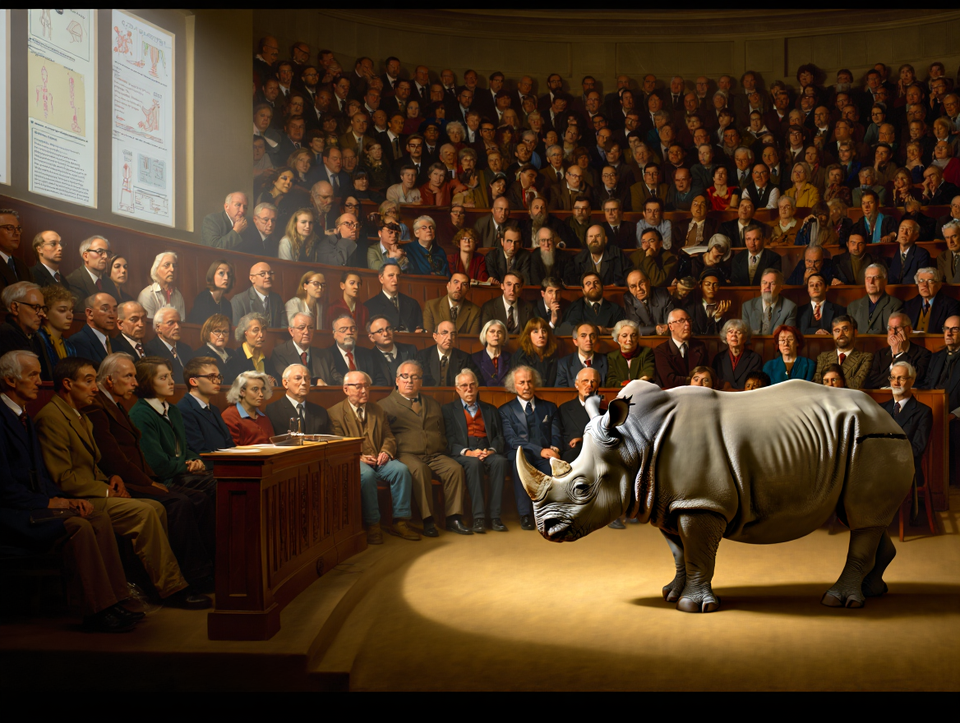
Who would you rather stand in front of: one thousand people you believe are smarter than you, or one rhinoceros?
Someone logical chooses the humans—there’s no “real” danger. They can’t impale you on their three-foot-long horn or trample you into a red smear. The worst thing humans do in most social situations is ridicule. But I’ve survived plenty of ridicule. I made it through middle school, ya know?
I do self-identify as a logical thinker, but one of the dirty secrets about human brains is that for all the lofty rhetoric of the prefrontal cortex, a much deeper group of neurons decides whether or not you dribble pee down your trousers at the moment of truth.
All of this is to describe exactly two terrifying experiences with rhinos. The first one happened while I was a vet student. I was at… let’s just say a not-one-hundred-percent-up-to-code wildlife sanctuary. As a young man, it was thrilling to get so much “free” (i.e., improper and dangerous) contact with exotic animals.
As much as I wanted to be scientifically minded and do the hard, nitty-gritty work of modern veterinary medicine, I had a hell of a lot of fun. I rode in the back of a truck through a herd of Cape buffalo, jumped over a fence to avoid a charging Watusi bull, and witnessed wildly inappropriate handling protocols for ultrapotent anesthetic drugs. At one point, someone handed me a water spray bottle and told me to walk through the giraffe pen to retrieve a spent anesthetic dart. If the 18-foot-tall giraffe got uncomfortably close, I could spray its nose with the bottle like it was a labradoodle (it worked, by the way).
But there was one moment that was true “Type 2” fun, which is fun so terrifying in the moment that you don’t know you’re having fun. Out with the head zookeeper for the day, we drove a backhoe into the rhino exhibit to do some maintenance on the grounds. The white rhinoceros—let’s call him Clyde—placidly watched the 10,000-plus-pound piece of machinery rumble into his one-acre enclosure of dirt, boulders, and concrete retaining walls.
If you’ve seen the movie Tremors, you know a backhoe is a pretty safe place to be when dealing with a monstrous beast that blindly charges at any sound in the vicinity. So I felt perfectly safe and was, in fact, mesmerized by the proximity to the rhino when my “supervisor” asked me to get out and stand in the center of the exhibit for a second.
Having no reason to distrust this “fine animal care professional” up until then, I simply got out and stood on one side of an irrigation ditch that was about the width of my pinky. He must have needed to adjust something underneath the panel where I had just been sitting. Or maybe he was going to hand me something to work on the ditch.
It wasn’t quite clear because it wasn’t explained, and it certainly never occurred to me that the backhoe would lurch off to the other end of the exhibit while I clenched my valves and noticed that nothing but a trickle of water stood between me and the rhino.
Being on foot with a 6,000-pound relic from the Stone Age is a bizarre feeling.
Clyde came trotting up. Not aggressive—more like a puppy excited to see a friend he just met at the park. But a cheerfully bounding rhino still carries an enormous amount of inertia, and there was nowhere to go.
Out of the corner of my eye, I saw my colleague smiling broadly and pointing to something. The irrigation ditch.
“Don’t cross that.”
Ohhhhhhhh-kay. Somehow, this safari park had leveraged the power of water to prevent megafauna attacks on humans. Fine. The spray bottle worked on the giraffe. I wouldn’t cross the trickle of water. What option did I have? At this point, Clyde had sauntered right up to the two-inch gap anyway. I couldn’t get any closer to him.
I could hear him grunting. I saw individual, frayed pieces of keratin sticking out sideways from his front horn. The dust at my feet rose when he exhaled through his nostrils.
But, honest to goodness, he stopped dead in his tracks when he sniffed the water.
We exchanged a few steady inhalations, and then I (stupidly and unnecessarily, though I’d probably do the same thing again) risked my life by taking a selfie with my phone to impress a girl I was dating.
After one more satisfying snort, Clyde ambled off. He didn’t seem in the least upset by the dangerous interaction he had just had with me.
Yes, that’s right—he was lucky. I’m a member of a species with a much worse track record of violence against rhinoceroses. In the millennia-long body count between us, we’ve racked up far more points. Even Clyde was a captive animal, completely at the mercy of the total nutjobs who ran that place.
Whereas I, as soon as the backhoe picked me up, could leave whenever I wanted.
To be fair to humans, it does appear we’ve changed our ways. Over many eons of moronically slow progress, we’ve become more caring. We actually want to see other creatures survive and thrive.
Which was a helpful thing to remember, especially when my second terrifying rhinoceros experience happened about six months later.
Still a lowly vet student, I was giving a case presentation at the American Association of Zoo Veterinarians annual conference. The vast majority of attendees were senior clinicians or researchers. Everyone was a licensed doctor of some sort, and I still wasn’t confident I’d ever make it out of school.
But I was lucky enough to have worked with a senior mentor on a case. One of the captive rhinos at a much more prestigious facility had been treated for a debilitating condition with a novel therapy, and I had helped write it up. Now I had to present it.
Walking onstage in front of one thousand of the smartest people I could imagine, my knees were buckling. I presented about ten minutes of terrified clinical reasoning—terrified on my part; the reasoning was my mentor’s, and it was sound—but the stage felt like it was shaking from a charging herd of rhinos.
I don’t remember that moment nearly as well as I remember the crystal-clear proximity of Clyde’s enormous rostrum up in my grill. It’s obvious I was far more terrified of simply standing and speaking to other humans than I was of standing in front of a six-thousand-pound prehistoric beast.
I knew the zoo veterinarians were more experienced than I was and would rigorously analyze everything I said. It was a deeply vulnerable position for someone spending so much time trying to enrich his brain.
But one thing helped me face this fear: the knowledge that these people were so exacting, so detailed, and so unrelenting in their quest for accuracy and clinical efficiency because they wanted to help rhinos.
After tens of thousands of years of strained relations between humans and wild animals, there was now a group of people using their giant brains to help rhinos. Yes, most of the problems wild animals face are caused by humans. But that doesn’t negate the efforts of those working to rectify the situation. It doesn’t make it meaningless that we try so hard to support the well-being of creatures different from ourselves.
It’s worth remembering that people are capable of incredible good. Even though we have enormous power and often act in brash, cantankerous ways, we can still find ways to live peaceably with others in our shared, limited space.
Just like Clyde did.


Comments ()